How Often Should You Walk Your Dog?
Most healthy adult dogs do well with two walks a day, each lasting roughly 20 to 30 minutes, totaling between 30 and 90 minutes of daily activity. Puppies need shorter, more frequent outings. Senior dogs generally do better with two or three slower, shorter walks. High-energy breeds may need an hour or two.
If you have seen conflicting advice on this, there is a reason, and it is worth clearing up before we go further.
Why You See Conflicting Advice
Some veterinary sources recommend walking your dog three to four times a day for at least 15 minutes each. Others say one or two walks daily is ideal. Both are correct, they are just counting differently.
The higher figure includes short bathroom trips. The lower figure counts only proper walks, with potty breaks treated separately. So a dog who goes out four times a day, twice for a quick garden trip and twice for a real 25-minute walk, satisfies both recommendations.
The useful way to think about it is total daily activity rather than number of outings. For most adult dogs, that target is 30 to 90 minutes, however, you choose to divide it up.
How Often to Walk Your Dog by Age
Puppies
Puppies need frequent, short outings rather than long walks. The widely used guideline is the five-minute rule: about five minutes of walking per month of age, up to twice a day, not counting bathroom trips. That means a three-month-old puppy needs roughly 15 minutes per outing, and a five-month-old around 25 minutes.
The limit is not about stamina, it is about skeletal development. Puppies have soft bones and joints, and growth plates do not close until around 12 months, with large and giant breeds not reaching skeletal maturity until 18 to 24 months. Over-exercising a puppy can cause lasting joint and limb problems, so this is one case where more is genuinely not better.
Separately from walks, puppies need frequent bathroom trips, often four to eight times a day and especially after eating, naps, and play. Keep puppy walks short, frequent, and focused on exploring and socializing rather than distance.
Adult Dogs
Adult dogs, generally between one and seven years old, depending on breed, are the ones for whom the standard advice applies. Two walks a day, each lasting 20 to 30 minutes, suit most healthy dogs in reasonable body condition. Total daily activity, including play, typically ranges from 30 to 90 minutes.
Dogs in excellent physical shape can handle considerably more, including walks of up to two hours or longer hikes. Overweight dogs are at the other end, and may struggle to manage even 10 minutes without needing breaks or panting heavily.
Senior Dogs
Older dogs still need to move, but the shape of it changes. Two or three shorter, slower walks of 10 to 30 minutes each usually work better than one longer outing, since it keeps them mobile without taxing their joints.
Middle-aged dogs from five to eight years and seniors from nine years up are more likely to have arthritis, muscle atrophy, or conditions like hypothyroidism or diabetes that reduce stamina. Watch how your dog recovers afterward rather than going by the clock, and adjust from there.
How Often to Walk Your Dog by Breed and Size
Breed makes a substantial difference, sometimes more than age.
High-energy and working breeds such as Border Collies, Huskies, Labradors, and Jack Russells often need one to two hours of activity daily and typically do better with multiple longer walks plus other outlets. These are the dogs most likely to develop problem behaviors when under-exercised, because a bored working dog will find its own job.
Moderate-energy breeds such as Basset Hounds and many mixed breeds do well with one or two moderate walks a day and are generally content with the standard recommendation.
Flat-faced breeds including Pugs, Bulldogs, French Bulldogs, and Boxers need a different approach. They overheat far more easily, so shorter sessions of 10 to 15 minutes in cooler parts of the day are safer, and you need to watch for signs of heat stress. In a Greensboro summer, this matters a great deal.
Small dogs can often meet their needs with less walking than large breeds, though this varies more by energy level than size. Plenty of small terriers need more exercise than a large, laid-back dog.
Signs Your Dog Is Not Getting Enough
Dogs rarely tell you directly. They tell you through behavior, and it is easy to read as a training problem when it is really an exercise problem.
Watch for restless pacing, barking that seems louder or more frequent than usual, chewing furniture or belongings, following you room to room, difficulty settling in the evening, or digging. Dogs left alone for long stretches without activity commonly show this kind of behavioral stress.
These behaviors usually reflect an under-stimulated dog rather than a badly behaved one. Adding a walk often resolves what looked like a training issue.
Signs Your Dog Is Getting Too Much
Less common, but worth knowing. Crashing hard after walks, limping, or general weakness can all indicate over-exercise. Puppies and senior dogs are most at risk, as are overweight dogs whose bodies work harder than their fitness level supports.
If your dog is stopping frequently, lagging, or lying down mid-walk, that is a clear signal to shorten the route rather than push through.
Why Consistency Matters More Than Distance
One reliable daily routine beats occasional long outings. Dogs are creatures of habit, and a predictable rhythm to the day builds real security. When walks happen at consistent times, dogs learn what comes next, which often shows up as steadier behavior in unfamiliar situations.
This is also where the health case sits. According to the Association for Pet Obesity Prevention, over half of US dogs are overweight or obese, which raises the risk of heart disease, joint problems, diabetes, and a shortened lifespan. Daily walks help manage weight, keep joints moving, and support healthy digestion. Moderate movement spread through the day does more for stiffness and circulation than a single hard session on a weekend.
It Is Not Only About Exercise
A walk does two jobs at once, and the mental side is easy to underestimate.
Dogs read the world through their noses, and a walk delivers a flood of information they cannot get indoors. Even a familiar route changes daily, which is why the same loop does not get boring for them the way it might for you. That sensory processing is genuinely tiring, which is why a dog can be physically fit and still restless if they are not getting out.
Walks also provide controlled exposure to the world, passing people, other dogs, cyclists, traffic noise. Those small experiences build confidence, help anxious dogs desensitize, and improve leash manners. For puppies and adolescent dogs, this is a core part of socialization rather than a side benefit.
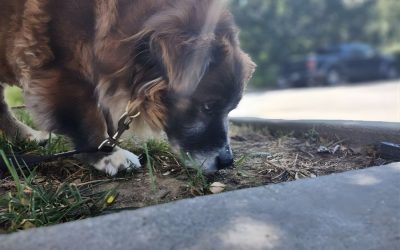
If you want to lean into the mental side specifically, a sniffari is a slow, dog-led walk built around sniffing rather than distance, and it tires many dogs more effectively than a brisk march.
What If You Cannot Walk Your Dog Every Day?
Realistically, most people miss days. Work runs long, weather turns, life happens. A few things help.
Something is better than nothing. Even 10 to 15 minutes of activity, supplemented with indoor play, keeps the routine from collapsing entirely on a bad day.
Split the difference where you can. Two short walks are often more practical than one long one, and dogs generally prefer it.
Vary the purpose. One walk can be brisk exercise, and another a slow, sniffing walk. They meet different needs.
And if your schedule genuinely does not allow for consistency, a professional dog walker fills the gap. This is especially worth considering if your dog is alone during the workday, since a midday walk breaks up a long stretch of time alone and covers the bathroom break at a sensible point in the day.
Frequently Asked Questions
How often should you walk your dog?
Most healthy adult dogs do well with two walks a day of 20 to 30 minutes each, totaling 30 to 90 minutes of daily activity. Puppies need shorter, more frequent outings, and senior dogs generally do better with two or three shorter, slower walks.
How many times a day should you walk your dog?
Once or twice a day for proper walks, plus additional short bathroom trips. Some veterinary sources recommend three to four daily outings of at least 15 minutes each, including those shorter potty breaks.
How long should I walk my dog?
For adult dogs, 20 to 30 minutes per walk is a solid baseline. High-energy breeds may need 1 to 2 hours of total daily activity, while flat-faced breeds do better with shorter 10- to 15-minute sessions to avoid overheating.
Is one walk a day enough for a dog?
For some dogs, yes. A single 20- to 30-minute walk can be enough for smaller, lower-energy, or senior dogs, particularly if they get other activity. Most adult dogs and nearly all high-energy breeds do better with two.
How long should I walk my puppy?
Follow the five-minute rule: roughly five minutes per month of age, up to twice a day. A four-month-old puppy needs about 20 minutes per outing. Longer walks risk damaging developing growth plates, which do not close until around 12 months of age, or 18 to 24 months in large breeds.
Can I walk my dog too much?
Yes. Crashing after walks, limping, or weakness are signs of over-exercise. Puppies, senior dogs, and overweight dogs are at the highest risk. Build up gradually rather than jumping into long walks.
Need Help Keeping the Routine Going?
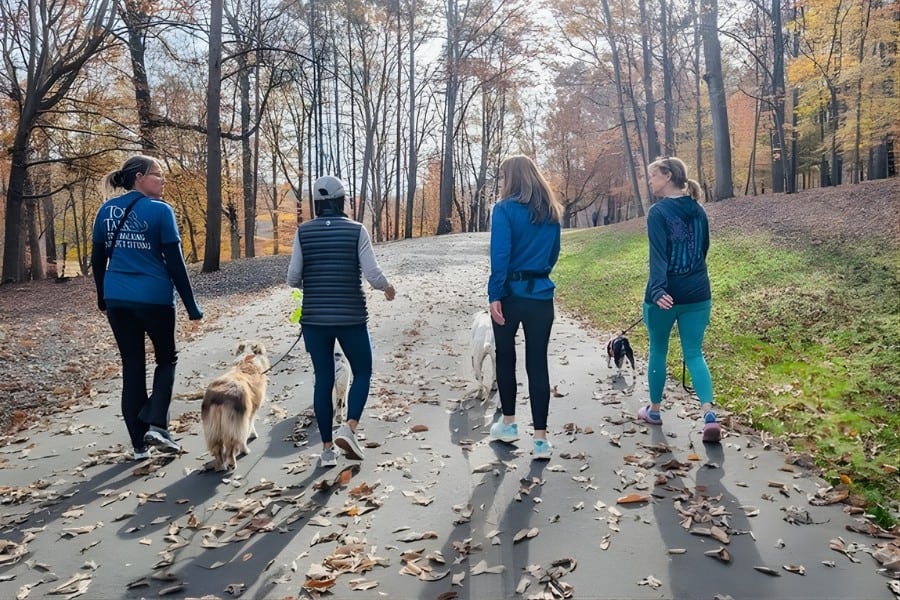
Consistency is the hard part, and it is the part that matters most. If work, travel, or a full schedule is making daily walks difficult, Top Tails can help. We provide reliable dog walking in Greensboro with GPS-tracked visits and a photo update after every walk, plus Adventure Walks for dogs who need a longer outing at local parks and trails.
If you are looking for somewhere new to go, our guide to the best places to walk your dog in Greensboro covers greenways, paved paths, and trails across the city.
Reach out any time, and we can work out a schedule that fits your dog.

Andrea is the founder of Top Tails of Greensboro LLC, a professional pet sitting and dog walking company in Greensboro, NC. She is certified in Pet CPR and First Aid and is a member of Pet Sitters International. Learn more about Andrea!